Call us today
1 (800) 275-0185

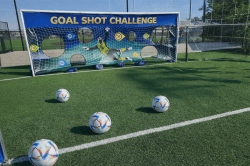
Whether you’re organizing a neighborhood mini-tournament for 40 players on a Saturday afternoon or building a fan zone for 500 people to watch a World Cup match together, the logistics of a community soccer event follow the same fundamental framework — and the gap between a well-run event and a chaotic one almost always comes down to how much of the planning happened before the day of.
This guide walks through every step of organizing a local soccer tournament or fan zone — from field securing and food truck coordination to player registration, bracket management, and the activities and rentals that keep attendees engaged from first kickoff to final whistle.
Perfect Parties USA supplies the interactive entertainment for community soccer events — mini soccer skills courses, giant inflatable soccer darts, penalty shootout games, foosball tables, radar kick speed machines, and everything else that fills the spaces between matches and keeps your crowd there all day. All available to rent, delivered, set up, and staffed by our team.
Before you book anything, communicate anything, or spend a dollar, you need clear answers to three foundational questions: How many people? What format? What’s the goal?
Attendance scale determines your venue size, your food volume, your permit requirements, and your activity zone footprint. A neighborhood tournament with 6 teams of 8 players is a completely different logistical operation from a community fan zone drawing 500 spectators during a World Cup match.
Tournament format determines your scheduling complexity. The most practical formats for community events:
Event goal shapes every other decision. A fundraiser tournament is organized differently from a World Cup watch party with a fan zone, which is organized differently from a community showcase event for a youth league. Get clear on what success looks like before planning anything else.
Field access is the critical path item in tournament planning — everything else can be adjusted, but if you don’t have a field, you don’t have an event.
Most communities have park-and-recreation field systems that allow organized event booking. Contact your city or county parks department 2–4 months in advance for a weekend event. Specify the number of fields you need, the date range, the expected attendance, and whether you’ll be charging admission or operating a commercial event — this affects permit requirements and field fees.
For a small-scale neighborhood tournament, a single full-size pitch can accommodate 4 teams in a round-robin format across a day. For 8–16 teams, plan for two to three adjacent fields to run matches simultaneously and keep your schedule moving.
Soccer clubs, private sports facilities, and schools occasionally rent their fields for community events — often at higher cost than municipal parks but with better maintenance, cleaner facilities, and sometimes existing spectator infrastructure (seating, restrooms, lighting). Contact local club administrators directly. Be specific about your event scope — number of participants, duration, setup requirements, and any equipment you’re bringing in.
For a fan zone event around a major match broadcast, your venue needs: a large screen (or space to set one up), sufficient power access for screens and sound, shade or shelter for afternoon events, and enough open space for your activity zone. Beer gardens, community halls, parking lots with a community space adjacent, and park pavilion areas are all commonly used. Some sports bars and restaurants will host free fan zone events in exchange for food and drink revenue — worth exploring if your event is focused on broadcast viewing rather than active play.
A well-managed registration process prevents the single most common tournament-day problem: not knowing who is actually coming until they show up.
Use a free or low-cost event registration tool — Google Forms, Eventbrite, or a sports-specific platform like LeagueApps or TeamLinkt — to collect team names, roster sizes, team captain contact information, and any entry fees. Set a registration deadline at least two weeks before your event so you have confirmed numbers for field planning, food ordering, and bracket seeding.
For a youth tournament, require a parent or guardian contact for every player and confirm that all players meet your age division requirements at registration, not on the day.
For a small community tournament, seeding is simple: if you have historical data (prior tournament results, league standings), use it. If not, randomize. Build your bracket or round-robin schedule before the event and distribute it to all team captains at least 48 hours in advance so every team knows their schedule.
For bracket management on the day, use a free bracket tool like Challonge or BracketHQ. Print physical copies and post them at the field, and designate one person as the bracket keeper whose sole job is updating results in real time and communicating schedule changes.
Designate a check-in table at the field entrance. Every team captain confirms their roster on arrival. Issue wristbands or team bibs. Confirm match start times for each team’s first game. Collect any remaining entry fees in cash or via a simple payment link.
This step is the one most first-time community event organizers underestimate. Permits and insurance are not bureaucratic obstacles — they’re what protects you, your participants, and your community relationship if something goes wrong.
Special event permit: Most municipalities require a permit for organized outdoor events above a certain attendance threshold (often 50–100 people). Apply through your city clerk, parks department, or municipal services office. Processing times vary from one week to 30 days — apply early.
Noise permit: If you’re running amplified sound (music, PA for bracket announcements, a fan zone with broadcast audio), you almost certainly need a noise permit. These typically require 30 days minimum notice.
Food vendor permits: If you’re bringing food trucks or food vendors, each vendor will need their own temporary food service permit from your health department. Confirm this with vendors before booking them.
Alcohol permits: If your fan zone involves alcohol service, you’ll need a temporary liquor permit in addition to all of the above. This process is longer and more complex — start at least 60 days out.
As the event organizer, you are responsible for event liability. Options:
Food keeps people at your event. A tournament where participants and spectators have to leave the venue to eat loses its crowd and loses its atmosphere during the exact windows when both are most important — between matches and at halftime.
Contact local food truck operators 4–6 weeks before your event. Provide the following: expected attendance, event hours, venue address and parking logistics for the truck, whether there’s a power hookup available, and whether you’re charging an access fee or offering a revenue split as compensation for the operator’s time.
For a morning-through-afternoon tournament, aim for two to three trucks covering different food categories — one savory main (burgers, tacos, sandwiches), one lighter option (wraps, salads, bowls), and one dessert or specialty drink option. This gives attendees variety, reduces per-truck lines, and keeps multiple parts of your food village active simultaneously.
For a fan zone around a major match, align your food truck selection with the game being broadcast if possible — serving traditional food from the nations playing adds a thematic layer that fan zone attendees consistently appreciate.
Beyond food trucks, Perfect Parties USA’s novelty food rentals add a carnival-food atmosphere to your concession zone that food trucks alone can’t provide:
Cotton Candy Art — enormous hand-spun clouds in custom colors, made fresh to order, becomes a visual attraction as much as a food station. Position it where people waiting for food trucks can see it.
Cotton Candy Burritos and Glow Cotton Candy for evening events create the kind of distinctive food moment that people photograph and share.
The Inflatable Popcorn Serving Window provides a high-volume outdoor serving station for popcorn that fits the community fair atmosphere of any outdoor soccer event perfectly.
A soccer skills course alongside your tournament fields serves a critical function: it gives players who are waiting for their next match something active to do, it engages spectators who want to participate rather than just watch, and it creates a secondary entertainment zone that keeps your event footprint populated throughout the full event day.
A mini soccer skills course typically runs in a defined zone adjacent to the main fields. Common station formats:
Dribbling and cone maze: A set of cones in a weaving pattern that players navigate as quickly as possible. Time each attempt. Post a fastest time leaderboard that updates throughout the day.
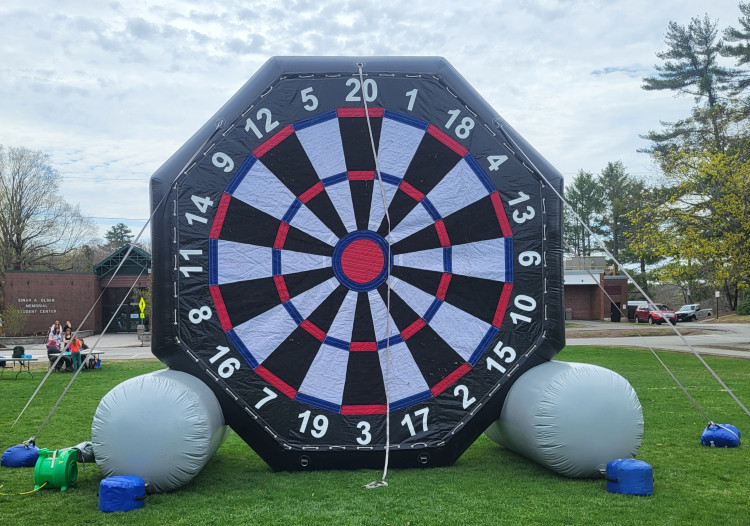
Target shooting accuracy: A net with numbered target zones. Players shoot from a fixed distance and compete for highest accuracy score. Giant Soccer Kick Darts provides a professional inflatable version of exactly this format — an oversized dart target played by kicking soccer balls, with point zones that reward accuracy at distance. It draws a watching crowd naturally and can run in open-play or bracket-competition format.
Juggling station: How many juggles can you complete without letting the ball touch the ground? Simple, requires no equipment beyond a ball and a counter, and is deeply satisfying for players of all skill levels.
Goalkeeper wall: A rebounder or wall target where players practice first touch and reaction saves in goalkeeper position.
The Soccer Speed Kick Deluxe — a radar kick speed machine — is the single most engaging solo activity station you can add to a community soccer event. Players line up, take their hardest kick, and see their speed in miles per hour displayed instantly.
Post a community leaderboard. Update it throughout the day. Watch players come back between matches to improve their score. Adults and players compete on the same leaderboard, which produces the most animated cross-generational competitive moments of any activity at the event.
For a youth tournament specifically, the radar kick machine provides every player with an individual measurement that connects directly to the skills they’re developing — a number that means something, that they remember, and that motivates them to train harder before the next tournament.
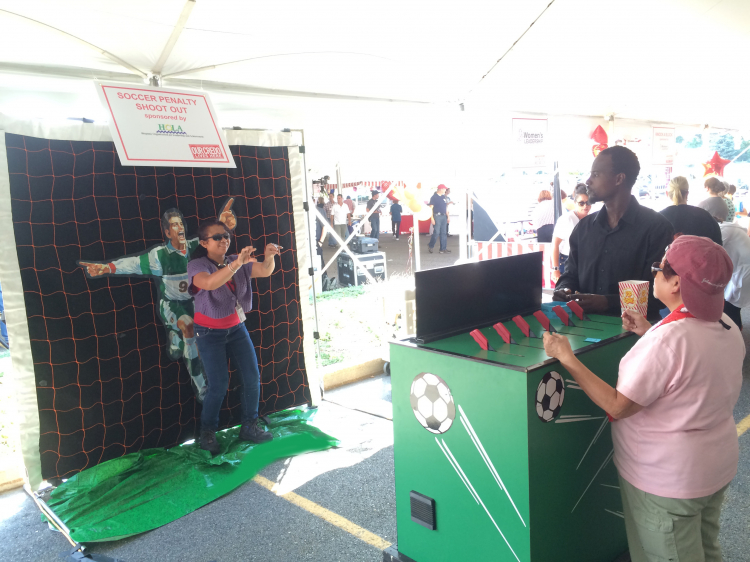
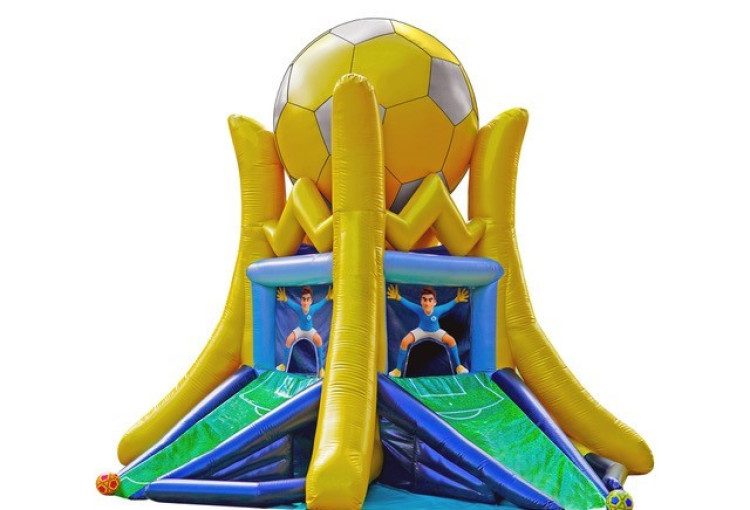
A dedicated penalty shootout zone provides the most thematically resonant competitive activity for a soccer event — everyone understands the stakes, everyone has an opinion about technique, and the head-to-head bracket format produces the most crowd-engaging competition of any station at your event.
Run it as an open bracket throughout the morning and early afternoon, with the penalty shootout final timed to coincide with the break before the tournament final. That sequencing — penalty final just before the main event — builds competitive energy throughout the day with a clear arc toward the tournament’s climax.
A fan zone transforms a passive viewing experience into a community event. Whether your fan zone is built around a World Cup match, a Champions League final, or a local league showcase match on a projector, the physical environment you create determines how long people stay and how much they enjoy the experience.
A proper screen and proper sound are non-negotiable for a fan zone. A small TV in a corner is not a fan zone. An outdoor screen — either a projector and a proper surface, an inflatable screen, or a large-format LED display — with an outdoor sound system that carries across your venue is the foundation everything else builds on.
For outdoor fan zones, position the screen so it’s visible from your activity zone and your food village — spectators should be able to watch the match from multiple positions within the venue, not just from directly in front of the screen.
Hay bales, picnic blankets, folding chairs, and standing rail areas all work for fan zone viewing. The key is defining a clear primary viewing area with enough capacity for your expected audience, while leaving sufficient standing room at the edges for guests who prefer to watch from the food or activity zone.
Fan zone attendees need something to do during commercial breaks, halftime, and the pre-match warmup period. The activity zone from Step 6 serves this function — position it adjacent to the main viewing area so the transition from watching to playing is immediate and obvious.
Add foosball tables — standard or 8-player format — within direct sightline of the main screen so spectators can play and watch simultaneously. Soccer Pong and Soccer Shuffleboard provide social gaming options that run continuously without structured programming.
LED Letters spelling “GOAL” near the screen create an organic crowd moment every time a goal is scored — hands go up, phones come out, the letters frame the celebration. Custom Marquees with your event name or the match details add visual production value to the fan zone space.
National flag bunting of all competing nations creates the international atmosphere of a proper World Cup fan zone and functions as décor and as a conversation starter simultaneously.
A Green Screen Photo Booth with a stadium backdrop gives fan zone attendees a keepsake photo experience that extends the event’s reach onto social media long after the final whistle.
A professional emcee or game facilitator running match-time activities — prediction competitions, bingo, trivia between halves — maintains crowd energy during slower match segments and organizes the halftime penalty bracket competition that the whole day builds toward.
The most important thing to understand about event day: by the time it arrives, planning should be complete. Event day is execution, not decision-making. If decisions are still being made on the morning of the event, the planning process wasn’t finished.
3–4 hours before gates open: Equipment delivery and setup begins. Inflatables, tent structures, staging, sound systems, and food vendor setup all require minimum 2–3 hours. Perfect Parties USA coordinates delivery windows during the booking process so all rentals are operational before your first guest arrives.
1–2 hours before gates open: Volunteer team briefing. Every volunteer knows their station, their responsibilities, and who to contact when something goes wrong. The bracket keeper has the schedule. The check-in team has the roster list. The activity zone operators have been briefed.
30 minutes before gates open: Final walkthrough of all stations. Power confirmed, all equipment operational, first aid station identified, signage in place, food trucks ready.
Designate a floating coordinator — typically the lead organizer — whose only job is to move between zones, identify problems, and resolve them before they become visible to participants and spectators. Every volunteer station can handle its own normal operations. The floating coordinator handles the abnormal.
Run bracket updates on a visible public scoreboard throughout the day. Participants who know the current standings stay invested in the event; participants who can’t find results lose interest and leave.
Keep your event photographer active from gates-open through the finals and awards. The photos become your event’s legacy content — the images that attract participants to next year’s tournament.
Position your awards ceremony between the tournament final and the fan zone’s main match (if running both). Use portable staging for the ceremony presentation, an emcee to run the program, and a confetti cannon for the championship team announcement. Close with a community photo — all tournament participants together — and your event has a proper ending rather than trailing off as people drift to their cars.
The work isn’t finished when the final whistle blows.
Venue restoration: Every field, park, or venue you used should be left in better condition than you found it. Collect all trash, remove all equipment, and restore any surfaces that were marked or altered. Your relationship with the venue for next year’s event depends on this.
Participant communication: Send a thank-you email to every team and participant within 48 hours. Include final standings, highlight photos from the event photographer, and — if you’re planning a repeat event — a save-the-date or registration link for next year.
Financial reconciliation: Reconcile your actual revenue (entry fees, sponsorships, food vendor percentage) against your actual costs (field rental, permits, equipment rental, food, prizes, staffing). This data is your planning baseline for next year and the document you show any sponsors or community partners who contributed.
Event retrospective: Write down what worked and what didn’t before memory fades. The three things you’d change and the three things you’d keep exactly the same are worth more than any planning checklist when you start organizing next year’s event.
Here’s the full list of Perfect Parties USA soccer-specific and event-production rentals that translate directly to community soccer tournaments and fan zones:
Skills zone and competition activities:
Fan zone table games:
Event production:
Photo and social:
Food and novelties:
Ready to get this party started? Contact Perfect Parties USA to talk to one of our Party Pros! Party With Us!
What do you need to organize a community soccer tournament?
To organize a community soccer tournament you need: a secured field or venue with sufficient space for your number of teams, a player registration system with confirmed rosters before event day, a tournament format (round-robin, single-elimination, or festival format) with a pre-built bracket, a special event permit and noise permit from your municipality, event liability insurance, food vendors or concession arrangements, a first aid plan, and a volunteer team assigned to specific roles including bracket management, check-in, and activity zones.
How far in advance should you start planning a community soccer tournament?
Start planning a community soccer tournament 3–4 months before your intended event date. Field reservation and permit applications often require 30–60 days processing time. Food truck operators book up quickly for weekend events in spring and summer. Equipment rental vendors like Perfect Parties USA should be contacted 6–8 weeks out for soccer skills zone equipment, with earlier contact recommended for events during peak season.
What activities keep spectators and waiting players engaged at a soccer tournament?
The most effective engagement activities at community soccer tournaments are a radar kick speed challenge with a live community leaderboard, a penalty shootout bracket competition timed to run between tournament matches, Giant Soccer Kick Darts for accuracy competition, foosball tables in open-play format, and a fan zone setup with a broadcast screen and social gaming stations. A professional emcee running match announcements and bracket updates maintains event energy between games.
How do you set up a fan zone for a community soccer event?
Setting up a community fan zone requires an outdoor screen (projector and surface, inflatable screen, or LED display) with a proper outdoor sound system, clearly defined seating and viewing areas with capacity for your expected audience, adjacent activity stations (foosball, penalty shootout, skills zone) for halftime and pre-match engagement, food and novelty concession stations, fan décor including flag bunting and LED “GOAL” letters, and a green screen photo booth for keepsake photos. A professional emcee running fan engagement activities — match trivia, prediction competitions, halftime penalty bracket — sustains crowd energy throughout the broadcast.
What permits do you need to host a community soccer event?
Common permits for a community soccer event include a special event permit from your municipality (required above a certain attendance threshold, typically 50–100 people), a noise permit for amplified sound (30 days minimum advance notice), temporary food service permits for each food vendor (coordinated through your local health department), and an alcohol permit if your fan zone includes alcohol service (allow 60+ days for this process). All vendor equipment suppliers, including Perfect Parties USA, provide certificates of insurance naming your organization as an additional insured.
How do you manage food and concessions at a community soccer tournament?
Contact food truck operators 4–6 weeks before your event. Aim for two to three trucks covering different food categories — one savory main, one lighter option, and one dessert or specialty item. Confirm power access, parking logistics, and compensation arrangement (access fee or revenue percentage) in advance. Supplement food trucks with novelty concession rentals like Cotton Candy Art and an Inflatable Popcorn Serving Window to add a festival atmosphere to your food village that food trucks alone don’t provide.
Can Perfect Parties USA supply equipment for community soccer tournaments and fan zones?
Yes — Perfect Parties USA supplies a complete range of soccer-themed and event production rentals for community soccer tournaments and fan zones, including radar kick speed machines, penalty shootout games, Giant Soccer Kick Darts, foosball tables, portable staging, sound systems, emcees, event photographers, confetti cannons, generators, fencing, photo booths, and novelty food stations. All rentals include delivery, professional setup, staffing, and teardown. Contact the team for a custom quote for your event.
Contact Perfect Parties USA to talk to one of our Party Pros!